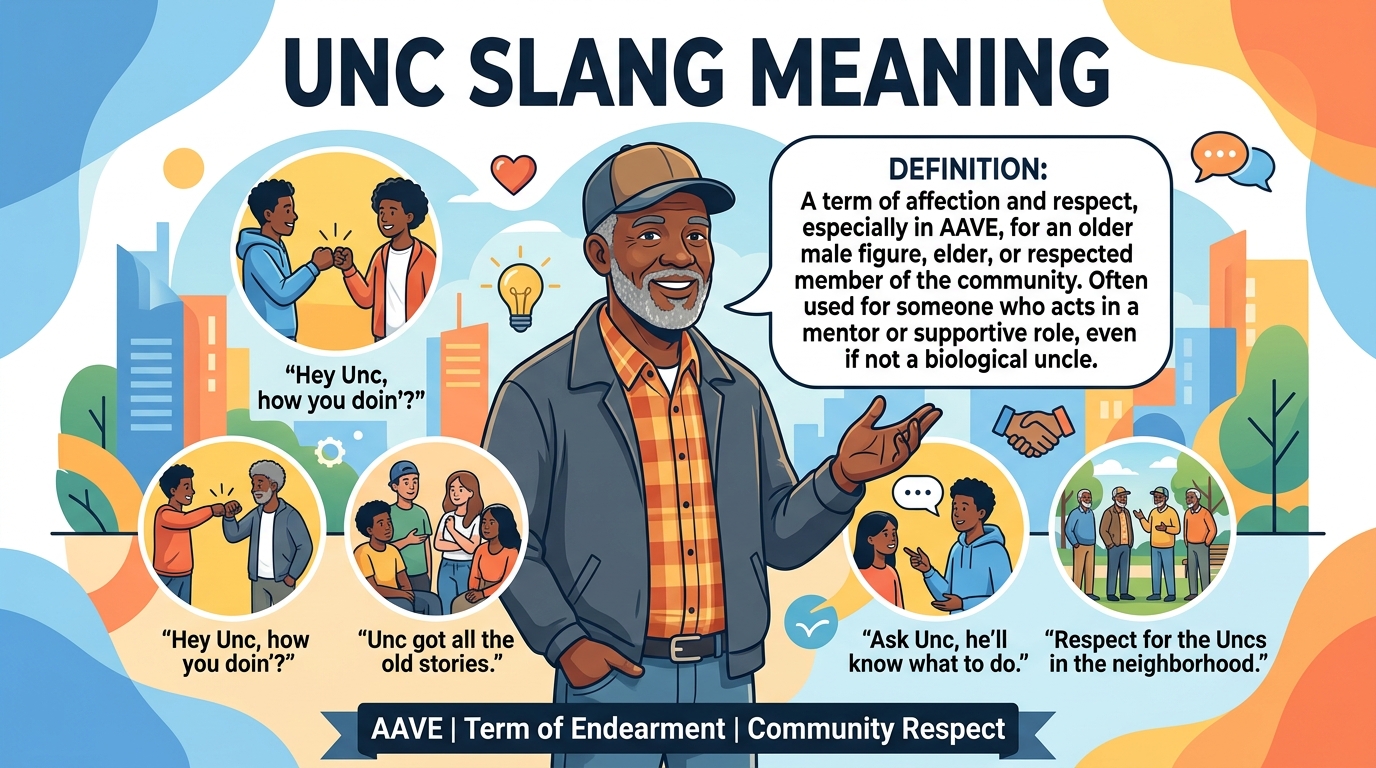
Unc Slang Meaning: The Full 2026 Gen Z Guide
If you have seen someone say “unc” in a TikTok comment, text, or social media post, you may wonder what it actually means. UNC slang is a popular Gen Z and internet expression used to refer to someone who seems older, out of touch, or gives “uncle” energy. The word comes from “uncle,” but online it is usually used playfully rather than literally.
Depending on the context, calling someone “unc” can be a joke about their age, fashion, opinions, behavior, or the way they talk. The term has become common across TikTok, Instagram, Snapchat, texting, and other social media platforms. In this guide, we’ll explain the UNC meaning in slang, where it came from, how Gen Z uses it, and examples of “unc” in everyday conversations.
Quick Answer: Unc Slang At a Glance
| Category | Details |
|---|---|
| Term | Unc |
| Short for | “Uncle” |
| Core meaning | Someone acting older, outdated, wise, or “uncle-like” — depending on context |
| Tone | Playful, teasing, respectful, or lightly insulting — context decides |
| Where it started | African American Vernacular English (AAVE), used affectionately for older men |
| Where it went viral | TikTok, June 2021, via the “unc status” trend |
| Main platforms | TikTok, Instagram, Snapchat, X (Twitter), Discord, texting |
| Related terms | Unc status, unc vibes, old head, boomer, auntie, chopped and unc |
| Still popular in 2026? | Yes — it’s outlasted most slang from its era |
Okay, that’s the cheat sheet. Now let’s actually dig in, because the short version doesn’t tell you the interesting part.
What Does “Unc” Mean?
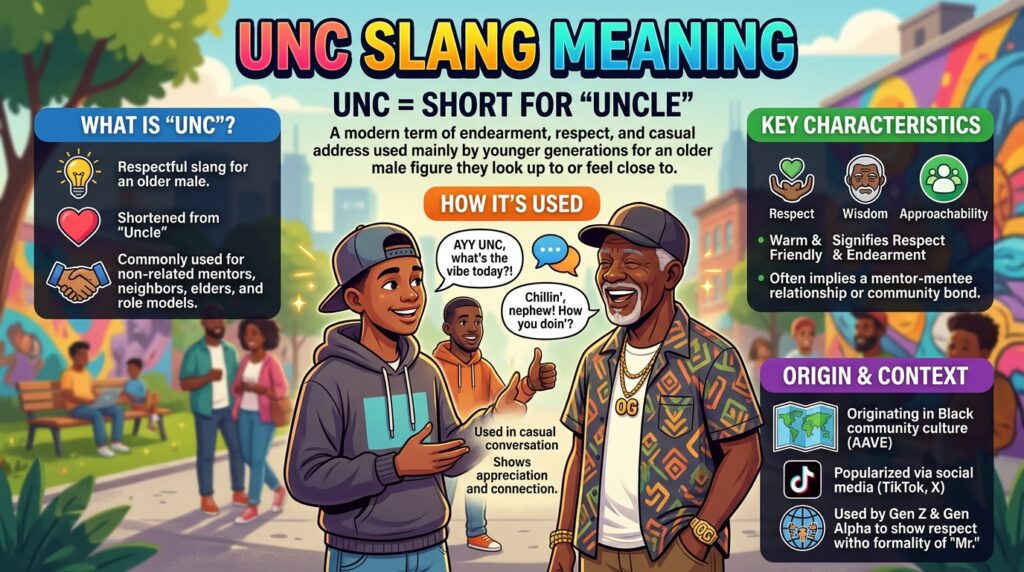
At its core, unc slang meaning boils down to this: unc is a shortened, casual form of “uncle,” used online and in texting to describe someone — usually a guy — who’s giving off older, wiser, or out-of-touch energy. That’s it. That’s the seed the whole trend grew from.
But here’s the thing people miss. Unc isn’t really about age. Not exactly. You can be nineteen and get called unc for saying you go to bed at 9 PM. You can be forty-five and dodge the label entirely because you know what “gyat” means (you probably shouldn’t, but you do). Unc is less about your birth certificate and more about a vibe — a slower, more settled, sometimes wiser, sometimes just plain old-fashioned energy that younger people clock instantly.
It carries a dual meaning too, and this trips a lot of people up. In its original form, it’s respectful. In its meme form, it’s a gentle roast. Same word, two completely different emotional temperatures depending on who’s saying it and why.
Where Unc Slang Comes From (And Why the Origin Matters)
This is the part a lot of slang explainers skip, or worse, get wrong. So let’s slow down here.
Unc didn’t start on TikTok. Not even close. It comes from African American Vernacular English — AAVE — where “unc” has been used for generations as an affectionate, respectful shorthand for an older man. Not just a blood-relative uncle, either. In Black communities, “unc” has long extended to mentors, community elders, the guy at the barbershop who’s been cutting hair since before you were born, the older cousin who taught you how to drive. It’s a term of closeness and respect, not mockery.
That respect-first meaning is really important to hold onto, because a lot of articles — and honestly, a lot of casual internet usage — flatten unc down into “old and uncool” without crediting where it came from. That’s a disservice to the culture that built it.
Hip-hop helped carry the word into wider view long before the TikTok explosion. You can hear it in Defari’s 2003 track “For the Love,” in Gucci Mane’s 2010 “On the Way,” and in J. Cole’s 2018 song “Brackets.” These weren’t throwaway lines — they reflected how the word already lived in everyday Black speech, long before mainstream internet culture picked it up.
So when you use “unc” today, you’re using a word with real roots. Worth knowing. Worth respecting.
The 2021 TikTok Viral Moment: How “Unc Status” Exploded
Here’s where the modern meme version kicks off, and honestly, it’s a pretty fun story.
In June 2021, a TikTok user posted a video that changed everything. A younger person greeted him with “Wassup unc” — casual, no big deal — and his caption read something like “When you realize you’ve OFFICIALLY reached ‘unc status.'” Disappointed face. Slight comedic despair. The internet ate it up.
Millions of people watched that video and felt something click. That specific, slightly humbling realization that you’re not the “young one” in the room anymore. The clip gave that feeling a name, and once something has a name, it spreads fast.
From there, “unc status” became its own standalone concept. Not just “he’s my uncle” — but a whole cultural marker for the exact moment you cross over from young-and-current to older-and-a-little-behind. TikTok creators ran with it. Stitches, duets, “signs you’ve reached unc status” compilations — the format multiplied like it always does once a trend has legs.
How Gen Z Uses “Unc” Today, Platform by Platform
Unc slang doesn’t behave the same way on every app. The tone shifts depending on where you’re seeing it. Let’s break it down.
TikTok
TikTok is where unc lives loudest. Comment sections under any video showing slightly outdated behavior — old dance moves, a dad joke, someone confused by a filter — fill up fast with “unc” references. It’s become shorthand. You don’t even need a full sentence anymore. Just “unc” does the job.
Instagram usage skews a bit softer. You’ll see it in comments on throwback photos or posts referencing older pop culture — “unc status achieved,” “giving unc energy.” Playful, a touch more restrained than TikTok’s chaos.
Snapchat
On Snapchat, it’s mostly private, friend-to-friend banter. Someone declines plans, and boom — “stop being unc” lands in the chat. Low stakes, high familiarity. This is where it feels most like an inside joke between people who actually know each other.
X (Twitter)
X keeps both meanings alive depending on who’s tweeting. Communities closer to the word’s AAVE roots tend to use it more traditionally — respectfully. Broader, meme-driven corners of the platform lean into the joke version. Context clues matter a lot here.
Texting
In plain text messages, unc is compact and efficient — perfect for a quick jab. “Bro said he’s tired at 9pm. Unc.” One word, whole point made.
Signs You’ve Reached “Unc Status”
Curious if you (or someone you know) qualify? Here’s the informal checklist the internet has basically crowdsourced over the past few years.
- You grunt, audibly, when you stand up or sit down
- Your stories start with “back in my day” more than once a week
- You need a teenager to explain a new app feature to you
- Cargo shorts still feel like a legitimate style choice
- You genuinely don’t know what “6-7” or “gyat” means and don’t especially care
- Loud restaurants have started to bother you, specifically
- Friday night at home sounds better than Friday night out
- You’ve said “music was better back then” unironically
None of these individually mean much. But stack a handful together, and yeah — congratulations, unc status achieved.
Unc vs. Boomer vs. Old Head: What’s the Difference?
People throw these three terms around like they’re interchangeable. They’re not. Each one carries its own tone, its own history, its own level of bite.
| Term | Origin | Tone | Typical Age Range | Respect Level |
|---|---|---|---|---|
| Unc | AAVE, hip-hop culture | Playful, affectionate, sometimes teasing | Mid-20s and up (flexible) | Medium-high — can be a compliment |
| Boomer | Baby Boomer generation, popularized via “OK boomer” | Dismissive, sometimes hostile | 55+ | Low — usually written off entirely |
| Old Head | Hip-hop and street culture | Respectful, describes wisdom + experience | Varies, often 40+ | High — carries genuine reverence |
The short version: boomer dismisses you. Old head respects you. Unc sits right in the middle — it can go either way depending on tone, relationship, and honestly, whether you’re being a good sport about it.
Is Unc an Insult or a Compliment? (Context Is Everything)
Honestly? This is the question everyone actually wants answered, so let’s not dance around it.
It depends. I know that’s an unsatisfying answer, but it’s the true one.
Among friends, “unc” is almost always affectionate teasing. Nobody’s trying to actually hurt your feelings when they call you unc for falling asleep at 10 PM during a movie. It’s a bit. A shared joke. The same energy as calling someone “old man” even though they’re twenty-six.
From a stranger online? Slightly different. It can land more like a jab, especially if it’s paired with something sharper, like “chopped and unc” — which, fair warning, is a much harsher combo, translating roughly to “unattractive and out of touch.”
And then there’s the compliment version, which people forget exists. When someone calls Denzel Washington “unc,” they don’t mean he’s uncool. They mean he’s earned it — respected, experienced, someone whose presence commands a little reverence. Same word. Completely different weight.
So really, ask yourself: who said it, what’s our relationship, and what was the tone? That tells you everything the word itself won’t.
Real Example Texts & How to Reply
Seeing it in the wild helps more than any definition. Here’s a batch of realistic examples, followed by some reply options if it happens to you.
Real examples:
- “Bro said he’s going to bed at 9. Unc.”
- “Okay unc, tell us that story again.”
- “Unc still uses a flip phone, I’m dead.”
- “Why is unc up at 5am on a Saturday.”
- “That’s some unc behavior right there.”
- “Unc really said ‘back in my day’ unprompted.”
How to reply, depending on your mood:
Casual:
- “I’ll take that.”
- “Fair, honestly.”
Funny:
- “Respect your elders.”
- “Watch your tone, youngster.”
Serious (if it’s actually bothering you):
- “I’m literally your age, relax.”
Confident / playful:
- “If I’m unc, what does that make you in five years?”
There’s no wrong way to respond, honestly. The bit only works if you play along a little.
Unc Slang in 2026: Is It Still Trending?
Short answer: yes, and that’s actually kind of unusual.
Most internet slang has a shelf life of maybe six to twelve months before it feels stale. “Unc,” by contrast, has held steady since its 2021 viral spike — and if anything, it’s gotten more embedded, not less. It’s shown up consistently in end-of-year slang roundups from major outlets, it’s got staying power across multiple platforms rather than being tied to just one app’s algorithm, and Gen Alpha — the generation right behind Gen Z — has already started using it themselves, which is usually the strongest signal a slang term has crossed from “trend” into “fixture.”
A few reasons it’s lasted:
- It’s flexible. Unlike a lot of slang tied to one specific joke format, “unc” adapts to basically any context — texting, comments, in-person conversation.
- It’s cross-generational. Millennials use it to self-deprecate. Gen Z uses it to tease. Gen Alpha is picking it up fast. That’s rare overlap.
- It has emotional range. Insult, compliment, inside joke, genuine respect — one word doing four jobs is efficient, and efficient slang tends to survive.
So no, “unc” isn’t going anywhere in 2026. If anything, it’s graduated from “trend” to just… part of how people talk now.
Related Gen Z Slang to Know
If “unc” made sense to you, these will too. Worth bookmarking.
| Term | Quick Meaning |
|---|---|
| Chopped | Unattractive or unfortunate-looking; often combined as “chopped and unc” |
| Rizz | Charisma, especially the romantic kind |
| Gyat | Exclamation, often reacting to someone’s appearance |
| 6-7 | A viral, intentionally nonsensical phrase/meme sound |
| Old Head | Respected older figure, hip-hop rooted |
| Auntie | The loose female equivalent of unc |
| No Cap | “No lie,” “for real” |
| Mid | Mediocre, unimpressive |
Slang doesn’t exist in isolation — it’s a whole ecosystem, and knowing the neighbors helps the main word make more sense.
Why Unc Culture Resonates (The Psychology Behind It)
Let’s take a small detour here, because I think it explains a lot.
Underneath the jokes, unc culture taps into something pretty universal: the low-grade anxiety of feeling like the world is moving faster than you are. Trends cycle so quickly now that something popular last month can genuinely feel dated by today. That’s not really new — every generation has felt the ground shift under them — but social media speeds up the timeline dramatically. What used to take a decade to feel “old” can now take a matter of months.
Calling someone unc, in a weird way, is also a form of self-protection. If you’re the one pointing out someone else’s unc behavior, you’re implicitly placing yourself on the “still current” side of the line. It’s a little bit of generational identity-building disguised as a joke. Gen Z bonds over spotting unc energy the same way older generations bonded over eye-rolling at their own parents.
And honestly? The humor softens what could otherwise feel like a genuinely uncomfortable topic — aging, relevance, feeling left behind. Comedy is just an easier entry point than a direct conversation about any of that.
AAVE, Credit, and Getting It Right
I want to circle back to this because it deserves more than a passing mention.
A lot of internet slang has a familiar life cycle: it starts in Black culture, gets adopted broadly online, and somewhere in the retelling, the origin quietly disappears. “Unc” has followed a version of that path. You’ll find plenty of slang roundups that explain the meme meaning in detail while barely mentioning — or straight-up ignoring — where the word actually came from.
That matters. Not in a “you’re not allowed to use it” way — slang spreads, that’s just how language works — but in a “know what you’re saying and where it’s from” way. If you’re going to use unc, saying it with some awareness of its AAVE roots costs you nothing and shows a bit of respect for the culture that built the word in the first place. Several Black creators on TikTok have made this exact point directly, pushing back on coverage that treats “unc” like it spontaneously generated on the app in 2021.
It didn’t. It had a life — a real, decades-long life — before any of us were duetting videos about it.
Regional and Community Differences
One more layer worth knowing: unc doesn’t mean exactly the same thing everywhere.
In communities closer to its AAVE roots, the traditional, respectful usage tends to stay stronger — it’s still primarily a term of warmth and closeness. In broader, more meme-driven corners of the internet, the joke version dominates almost entirely, and a lot of users genuinely don’t know the respectful version exists at all.
Platform culture shapes this too. Gaming communities and comment sections skew toward the teasing use — quick, reactive, thrown into a live chat. More community-driven spaces, where people actually know each other, tend to lean back toward the original, warmer meaning. So the “correct” read on any given “unc” really depends on who’s in the room, so to speak.
Frequently Asked Questions
What does unc mean in texting?
It’s short for “uncle,” typically used to jokingly call someone out for acting old, outdated, or overly mature in a text conversation.
Is being called unc disrespectful?
Usually not. Among friends, it’s playful teasing. In its original AAVE usage, it’s actually a term of respect. Tone and relationship decide how it should land.
At what age do you become unc?
There’s no set number. Some people get labeled unc in their mid-20s based on behavior alone; others avoid it well into their 40s by staying culturally current.
What’s the difference between unc and boomer?
Boomer tends to dismiss someone entirely. Unc is friendlier — it can acknowledge someone’s getting older while still respecting them.
Where did unc slang originate?
It comes from African American Vernacular English, where it’s long been used as respectful shorthand for an older man or mentor, well before its 2021 TikTok viral moment.
Can women be called unc?
Traditionally unc refers to men, and “auntie” is the loose female counterpart — though usage varies, and some people apply “unc” more loosely regardless of gender.
Is unc the same as old head?
Close, but not identical. Old head leans more purely respectful and comes straight out of hip-hop culture. Unc covers a wider range — respect, teasing, or straight-up comedy, depending on context.
Why is unc status trending on TikTok?
Because it’s universally relatable. Everyone eventually feels that moment of “wait, am I the old one now?” — and TikTok’s short, punchy format is perfect for turning that feeling into shareable content.
What does “chopped and unc” mean?
It’s a harsher combo phrase meaning someone is both unattractive and out of touch — a sharper insult than “unc” used alone.
Should I be offended if someone calls me unc?
Probably not. Check the relationship and tone first. Most of the time it’s affectionate ribbing, not a real insult — and honestly, everyone becomes unc eventually. Might as well laugh about it.
Conclusion
So — unc slang. What started as respectful AAVE shorthand for an older man turned into a full-blown internet phenomenon, thanks largely to one viral TikTok moment back in 2021. And somehow, unlike most slang that flames out fast, it’s stuck around, evolved, and even picked up a whole vocabulary of its own — unc status, unc vibes, chopped and unc, the works.
Here’s the thing worth remembering, though: the roots matter. This isn’t just a meme word that appeared out of nowhere. It carries real cultural weight, and using it with a little awareness of where it came from goes a long way.
Whether you’re getting called unc for going to bed early, or you’re the one dropping it on a friend who just said “back in my day” for the third time this week — you get it now. The tone, the history, the platforms, all of it.
And hey, if you’re feeling a little unc yourself after reading all this? Don’t worry. We’re all headed there eventually. Might as well own it.

Core Net Worth is a trusted source for celebrity net worth, biographies, career insights, and wealth analysis. We publish well-researched, fact-based content that helps readers understand the financial journeys, income sources, career achievements, and success stories of public figures. Our editorial approach prioritizes accuracy, transparency, and trustworthy reporting.