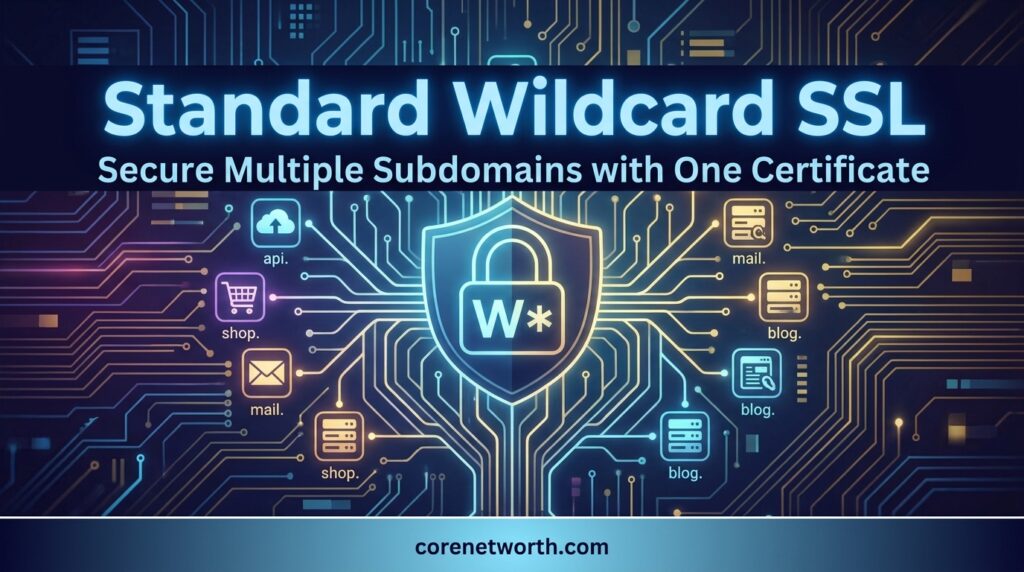



Standard Wildcard SSL is a practical security solution for websites that need to protect a main domain and multiple subdomains with a single SSL certificate. Instead of purchasing and managing separate certificates for every subdomain, a wildcard certificate can secure a domain such as example.com along with subdomains like blog.example.com, shop.example.com, and login.example.com. This makes website security easier to manage while helping protect sensitive information exchanged between users and your website.
For businesses, online stores, organizations, and growing websites, Standard Wildcard SSL can provide an efficient balance of security, convenience, and cost savings. It typically offers domain validation and enables HTTPS encryption, helping protect data from interception while also giving visitors the familiar padlock and secure connection indicators in their browser. Understanding how Standard Wildcard SSL works, its benefits, limitations, pricing, and suitable use cases can help website owners choose the right SSL certificate for their online presence.
What Is Standard Wildcard SSL?
A Standard Wildcard SSL certificate is a TLS/SSL certificate designed to secure one domain and its first-level subdomains through a wildcard name such as *.example.com.
The asterisk (*) acts as a placeholder for a single subdomain level. This means one certificate can protect hosts such as:
www.example.comblog.example.comshop.example.commail.example.comsupport.example.comapi.example.com
This is why wildcard certificates are useful for websites with multiple services operating under the same domain.
Definition
In simple terms, Standard Wildcard SSL provides HTTPS encryption for a primary domain’s covered first-level subdomains.
It normally belongs to the domain-validation category when sold as a standard DV wildcard product, although wildcard certificates can also exist with other validation options depending on the provider.
The certificate helps establish an encrypted connection between the visitor’s browser and your web server.
How It Works
When someone visits an HTTPS website, the browser checks the site’s TLS certificate and establishes a secure connection with the server.
For a wildcard certificate, the browser checks whether the requested hostname matches the certificate’s wildcard name.
For example:
*.example.com
can match:
blog.example.com
shop.example.com
api.example.com
But it doesn’t match:
dev.api.example.com
The wildcard therefore provides scalable protection without requiring a separate certificate for every first-level subdomain.
Why Businesses Use It
Businesses often create subdomains for different services.
| Business Function | Example |
|---|---|
| Main website | www.example.com |
| Blog | blog.example.com |
| Store | shop.example.com |
| Customer portal | portal.example.com |
| Support | support.example.com |
| API | api.example.com |
Managing individual certificates for every hostname can increase administrative work.
A wildcard certificate provides a more centralized approach.
How Does a Standard Wildcard SSL Certificate Work?
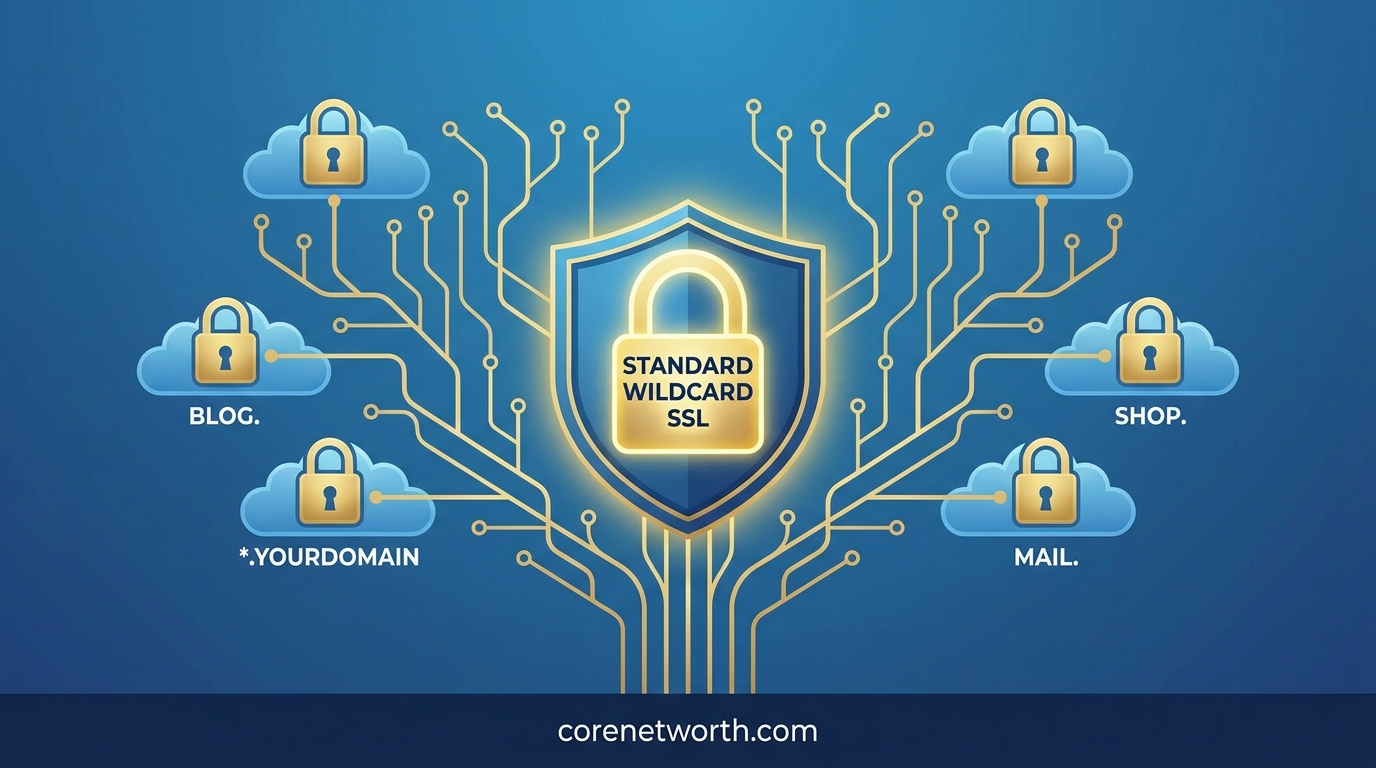
The main technology behind a Standard Wildcard SSL certificate is TLS, which creates an encrypted connection between the visitor and the website.
The general process is:
- A visitor opens an HTTPS URL.
- The server presents its TLS certificate.
- The browser checks the certificate.
- The hostname is matched against the certificate.
- The TLS handshake establishes secure session keys.
- The browser and server communicate through an encrypted connection.
This process helps protect information while it travels between the visitor and the server.
Encryption Process
Encryption helps prevent unauthorized parties from simply reading data transmitted between a browser and server.
This is important for information such as:
- Login credentials
- Account information
- Contact details
- Payment information
- API requests
- Private communications
Modern TLS deployments can use cryptographic technologies such as RSA or ECC and secure hashing algorithms such as SHA-256.
However, an SSL certificate is only one part of website security. Secure software, server configuration, access controls, authentication, and regular updates are still important.
Wildcard Symbol Explained
The most recognizable feature of a wildcard certificate is the asterisk.
For example:
*.example.com
Here, * represents one first-level hostname.
Therefore:
blog.example.com → covered
store.example.com → covered
login.example.com → covered
But:
dev.api.example.com → not covered by *.example.com
This one-level limitation is important when designing your certificate strategy.
Subdomain Coverage
A Standard Wildcard SSL certificate is particularly useful when a company has many first-level subdomains.
For example:
| URL | Covered by *.example.com? |
|---|---|
www.example.com | Yes |
blog.example.com | Yes |
shop.example.com | Yes |
api.example.com | Yes |
support.example.com | Yes |
dev.api.example.com | No |
test.shop.example.com | No |
If your organization uses nested subdomains, you may need another wildcard at the appropriate level or a Multi-Domain/SAN certificate.
Key Features of Standard Wildcard SSL
A Standard Wildcard SSL certificate combines several useful features for websites that depend heavily on subdomains.
Unlimited First-Level Subdomains
One of the biggest advantages is the ability to cover multiple first-level subdomains under the same wildcard domain.
You can add new first-level subdomains without buying an individual certificate for every hostname.
This is especially useful for growing websites and platforms that regularly add new services.
Strong Encryption
SSL/TLS certificates protect data in transit by establishing encrypted HTTPS connections.
This can help protect:
- Passwords
- Login sessions
- Customer information
- Payment data
- API traffic
The certificate itself doesn’t make the entire website secure, but it provides an important layer of transport security.
Browser Compatibility
Publicly trusted certificates are designed to work with modern browsers and operating systems.
When the certificate is correctly issued and configured, visitors can access the website through HTTPS without receiving certificate trust warnings.
Fast Issuance
Many standard wildcard products use Domain Validation.
The Certificate Authority verifies control over the domain before issuing the certificate. Depending on the provider and validation method, issuance can be relatively quick.
DNS validation is commonly used for wildcard certificates.
Easy Renewal
Instead of tracking separate certificates for every first-level subdomain, a wildcard certificate can simplify certificate lifecycle management.
That means fewer certificates to monitor and potentially fewer opportunities to forget a renewal.
Keep in mind, however, that modern public TLS certificate lifetimes are getting shorter. Industry changes in 2026 mean website owners should plan for more frequent renewal or automated certificate management.
Benefits of Using Standard Wildcard SSL
A Standard Wildcard SSL certificate can provide several practical advantages for businesses with multiple subdomains.
Improved Website Security
HTTPS encrypts information exchanged between a browser and server.
This is particularly important for:
- Login pages
- Customer portals
- Online stores
- APIs
- Account dashboards
- Contact forms
Wildcard certificates extend this HTTPS coverage to the first-level subdomains included by the wildcard name.
Better SEO
HTTPS is a lightweight Google ranking signal.
However, don’t expect a wildcard certificate by itself to produce higher rankings.
The SEO value is more indirect. HTTPS helps create a secure technical foundation, avoids certificate-related browser warnings, and allows subdomains to operate consistently over secure connections.
Your content quality, relevance, technical SEO, backlinks, page experience, and other factors still matter much more.
Customer Trust
Security warnings can make visitors uncomfortable.
A correctly configured HTTPS connection gives users a familiar secure browsing experience.
This is especially important for websites where people:
- Log in
- Create accounts
- Submit forms
- Make purchases
- Share personal information
Cost Savings
Suppose a company operates ten first-level subdomains.
Buying and managing ten separate certificates could create unnecessary administrative work.
A wildcard certificate can consolidate coverage under one certificate, which may reduce certificate management costs at scale. Providers specifically market wildcard certificates as a way to simplify management across multiple subdomains.
Simplified Certificate Management
Certificate management becomes more complicated as websites grow.
A centralized wildcard certificate can reduce the number of individual certificates that administrators need to track.
That can simplify:
- Installation
- Renewal
- Monitoring
- Certificate inventory
- Deployment
There’s an important trade-off, though: the wildcard private key must be protected carefully because one compromised key can affect multiple covered services.
Standard Wildcard SSL vs Single Domain SSL
A Single Domain SSL certificate is designed for one specific domain or hostname.
A wildcard certificate is designed for multiple first-level subdomains under a domain.
| Feature | Single Domain SSL | Standard Wildcard SSL |
|---|---|---|
| One hostname | Yes | Yes |
| Multiple first-level subdomains | No | Yes |
| HTTPS encryption | Yes | Yes |
| Best for simple websites | Yes | Not necessary |
| Best for many subdomains | Limited | Yes |
| Centralized subdomain management | No | Yes |
If you operate only one website without multiple subdomains, a Single Domain SSL certificate may be simpler.
If your website has many first-level subdomains, wildcard protection can be more practical.
Standard Wildcard SSL vs Multi-Domain SSL
These certificates solve different problems.
A wildcard certificate is primarily useful for multiple subdomains under one domain.
A Multi-Domain SSL certificate, often called a SAN certificate, allows multiple specified domain names or hostnames to be included in one certificate.
For example:
Wildcard:
*.example.com
Multi-Domain:
example.com
example.net
anotherwebsite.com
A SAN certificate can therefore make more sense when your organization manages different domains.
| Feature | Wildcard SSL | Multi-Domain SSL |
|---|---|---|
| Multiple first-level subdomains | Yes | Possible by individual names |
| Multiple root domains | No | Yes |
| Wildcard support | Yes | Depends on product |
| Best for | One domain + subdomains | Multiple domains |
| Certificate management | Centralized | Centralized |
Neither option is universally better.
The right choice depends on your domain structure.
Who Should Buy a Standard Wildcard SSL?
A Standard Wildcard SSL certificate is most useful for organizations with several first-level subdomains.
eCommerce Stores
An online store might use:
shop.example.comaccount.example.comsupport.example.comcheckout.example.com
A wildcard certificate can simplify HTTPS management across these services.
SaaS Companies
SaaS platforms often depend on several subdomains:
app.example.comapi.example.comlogin.example.comdashboard.example.comsupport.example.com
Wildcard certificates can be particularly convenient for environments that frequently create new first-level subdomains.
Corporate Websites
Large companies may have separate subdomains for:
- Careers
- Customer portals
- Support
- News
- Applications
- Internal services
A wildcard certificate can simplify certificate management when these services share the same domain.
Educational Websites
Schools, universities, and online learning platforms can use multiple subdomains for:
- Student portals
- Online courses
- Libraries
- Authentication
- Learning management systems
When these are first-level subdomains, wildcard coverage can be useful.
Agencies
Digital agencies and development teams may manage several services under one domain.
A wildcard certificate can reduce repetitive certificate administration, especially when new subdomains are added regularly.
How to Install a Standard Wildcard SSL Certificate
Installing a Standard Wildcard SSL certificate normally involves four major stages.
Generate CSR
Start by generating a Certificate Signing Request (CSR) on your server.
For a wildcard certificate, the requested name is typically:
*.example.com
The CSR works with the private key used for the certificate.
Keep that private key secure. Don’t share it publicly or store it in an insecure location.
Validate Domain
The Certificate Authority needs to verify that you control the domain.
Common validation methods include:
- DNS validation
- HTTP validation
- Email validation
DNS validation is especially common for wildcard certificates.
Your CA will provide the required DNS record. Add it to your domain’s DNS configuration and wait for validation.
Install Certificate
After validation, the Certificate Authority issues the certificate.
Depending on your hosting environment, you may install it through:
- cPanel
- Plesk
- Apache
- Nginx
- IIS
- Cloud platforms
- CDN or load-balancing services
You may also need to install the intermediate certificate or certificate chain.
Test HTTPS
After installation, test every important hostname.
For example:
www.example.comblog.example.comshop.example.comapi.example.com
Check for:
- Certificate errors
- Expiration problems
- Hostname mismatches
- Certificate-chain issues
- Mixed content
- Incorrect HTTP-to-HTTPS redirects
A successful installation should provide a valid HTTPS connection without browser certificate warnings.
Pricing of Standard Wildcard SSL Certificates
The price of a Standard Wildcard SSL certificate varies by provider, validation type, support, warranty, subscription structure, and other features.
Current marketplace pricing illustrates why you should compare providers rather than assume there is one standard price. For example, Namecheap currently lists its Standard Wildcard SSL at a promotional annual price, while SSL.com lists different wildcard products and pricing.
Pricing can also change over time.
When comparing certificates, look at:
- Annual cost
- Renewal price
- Validation type
- Warranty
- Support
- Server compatibility
- Automation options
- Reissuance policy
- Certificate management features
Don’t choose based only on the first promotional price you see.
Is Standard Wildcard SSL Worth the Cost?
For a simple website with one hostname, probably not.
A basic Single Domain SSL certificate may be enough.
But consider a company operating:
shop.example.comblog.example.comportal.example.comsupport.example.comapi.example.com
In this situation, wildcard coverage can reduce certificate-management complexity.
The real value isn’t only the certificate’s purchase price.
It’s also the time saved managing multiple certificates.
Common Mistakes to Avoid
Even a well-designed certificate can cause problems if it’s configured incorrectly.
Assuming It Covers Nested Subdomains
*.example.com doesn’t automatically cover:
dev.api.example.com
The wildcard only covers one level.
Forgetting the Root Domain
Don’t automatically assume that *.example.com means example.com.
Check the actual certificate names and SAN entries. Current providers differ in how they package apex-domain coverage.
Losing the Private Key
The private key is a critical security asset.
Store it securely and limit access to authorized administrators.
Installing an Incomplete Certificate Chain
A missing intermediate certificate can cause trust problems on some clients.
Make sure the full certificate chain is correctly configured where required.
Forgetting HTTPS Redirects
Installing a certificate doesn’t necessarily force every HTTP request to HTTPS.
Configure appropriate HTTP-to-HTTPS redirects for your website.
Ignoring Mixed Content
After enabling HTTPS, check whether your pages still load resources through HTTP.
Images, scripts, stylesheets, fonts, and other resources should generally be served securely.
Using the Same Private Key Carelessly
Wildcard certificates can simplify deployment, but distributing the same private key across many servers increases the potential impact of a key compromise.
DigiCert specifically warns that using one wildcard certificate and corresponding private key across multiple devices can increase security risk.
Waiting Until Expiration
Don’t wait until the last day to renew.
With certificate lifetimes becoming shorter, automated renewal and certificate monitoring are increasingly important.
Frequently Asked Questions
What is the difference between standard SSL and wildcard SSL?
Standard SSL usually secures one domain or specific hostnames, while Wildcard SSL secures a main domain and unlimited subdomains under it.
How much is a wildcard SSL?
Wildcard SSL prices vary by certificate provider, validation type, and term, ranging from free options to paid certificates.
What is a standard SSL certificate?
A standard SSL certificate encrypts data between a website and its visitors and enables HTTPS for a specific domain.
How to get a wildcard SSL certificate?
Choose an SSL provider, select a Wildcard SSL certificate, complete domain validation, and install the issued certificate on your server.
Standard Wildcard SSL: Quick Comparison
| Certificate | Best For | First-Level Subdomains | Multiple Domains |
|---|---|---|---|
| Single Domain SSL | One hostname | Limited | No |
| Standard Wildcard SSL | One domain with many subdomains | Yes | No |
| Multi-Domain SSL | Multiple domains | Individual entries | Yes |
| Multi-Domain Wildcard | Complex environments | Depending on configuration | Yes |
Conclusion
A Standard Wildcard SSL certificate is a practical choice for websites that rely on multiple first-level subdomains under the same domain. It can simplify HTTPS deployment, reduce certificate-management work, and make it easier to scale a growing website.
But wildcard doesn’t mean unlimited coverage of every possible hostname.
Before purchasing, check your actual domain structure. Make sure you understand first-level versus nested subdomains, verify whether the root domain is included, protect your private key, and plan for certificate renewal.

Core Net Worth is a trusted source for celebrity net worth, biographies, career insights, and wealth analysis. We publish well-researched, fact-based content that helps readers understand the financial journeys, income sources, career achievements, and success stories of public figures. Our editorial approach prioritizes accuracy, transparency, and trustworthy reporting.
Leave a Reply