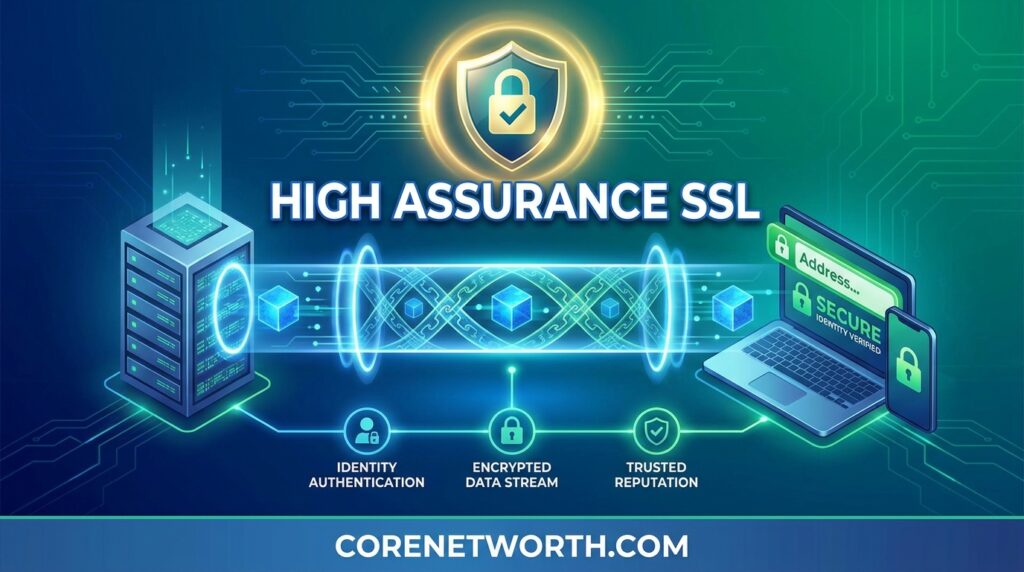



High Assurance SSL is a type of SSL certificate designed for businesses that want more than basic website encryption. It can help verify the identity of an organization while securing information exchanged between visitors and a website. For companies, online stores, and professional websites, this extra level of validation can make a difference when building customer trust.
But there’s some confusion around the term. Is High Assurance SSL the same as an OV SSL certificate? Is it more secure than a standard SSL certificate? How much does it cost, and does every website really need one?
What Is High Assurance SSL?
A High Assurance SSL certificate is an SSL/TLS certificate that provides HTTPS encryption while offering a higher level of organization validation than a basic Domain Validation (DV) certificate.
With a standard DV certificate, the Certificate Authority (CA) mainly confirms that the applicant controls the domain. High Assurance SSL commonly goes further by validating information about the organization behind the website.
That makes it particularly useful for businesses that want to show visitors that a real organization operates the website.
In simple terms:
DV SSL = proves control of a domain.
High Assurance SSL / OV SSL = proves domain control and validates the organization.
EV SSL = provides a more extensive business validation process.
The exact product name can vary between SSL providers, so it’s important to check the certificate’s actual validation level rather than relying only on the marketing name.
How High Assurance SSL Works
When you purchase High Assurance SSL, a Certificate Authority checks the information required for the certificate.
The general process looks like this:
- You select an SSL certificate.
- You submit your domain and organization information.
- The Certificate Authority verifies the required details.
- The certificate is issued after validation.
- You install the certificate on your web server.
- Your website becomes available through HTTPS.
The certificate uses encryption to help protect information traveling between the visitor’s browser and your website.
This can include information such as login details, contact forms, and payment-related data transmitted through an encrypted connection.
What Does High Assurance SSL Verify?
Depending on the certificate and provider, validation can involve checking:
- Domain ownership or control
- Organization information
- Business registration details
- Organization identity
- Contact information
- Other information required by the Certificate Authority
This is one of the biggest differences between an organization-validated certificate and a basic DV certificate.
Is High Assurance SSL the Same as OV SSL?
In many cases, High Assurance SSL is used as a product or marketing name for an Organization Validation (OV) SSL certificate.
However, you shouldn’t assume that every certificate using the words “High Assurance” has exactly the same features.
Always check:
- Validation type
- Domain coverage
- Warranty
- Certificate authority
- Renewal price
- Issuance requirements
The important thing is the certificate’s actual validation level, not just its product name.
How Does High Assurance SSL Validate a Business?
One of the main reasons businesses choose High Assurance SSL is organization validation.
Instead of only checking whether someone controls a domain, the Certificate Authority can verify information about the organization associated with that domain.
Domain Ownership Verification
First, the Certificate Authority needs to establish that the applicant has control over the domain.
This helps prevent someone from simply requesting a certificate for a website they don’t control.
Domain verification is also used with DV and other SSL certificate types.
Business Registration Verification
For an organization-validated certificate, the Certificate Authority may verify information about the business through appropriate records and sources.
This helps establish that the organization is a legitimate entity.
The exact documentation and verification process can differ depending on the Certificate Authority and jurisdiction.
Organization Identity Verification
The organization itself may need to be verified before the certificate is issued.
This gives an OV certificate an additional identity-validation layer compared with a basic DV certificate.
For a business website, this can provide useful reassurance to customers who want to know who operates the site.
Certificate Issuance
After the required validation steps are completed, the Certificate Authority can issue the SSL/TLS certificate.
The certificate can then be installed on the website’s server.
The time required for issuance varies. DV certificates can usually be issued faster, while organization validation can require additional checks.
High Assurance SSL Features
A good High Assurance SSL certificate can provide several useful features for businesses.
Organization Validation
Organization validation is one of the defining features associated with High Assurance and OV certificates.
It provides more information about the organization than basic domain validation.
HTTPS Encryption
SSL/TLS certificates enable HTTPS, which encrypts data transferred between a website and a visitor’s browser.
This is particularly important for websites that handle accounts, forms, transactions, or other private information.
Single-Domain Protection
Some High Assurance products are designed to protect a single domain.
For example, a certificate might protect:
example.com
Depending on the certificate, additional coverage may require a wildcard or multi-domain product.
Always check the certificate’s domain coverage before purchasing.
Browser Compatibility
Modern SSL/TLS certificates are designed to work with commonly used browsers and devices.
However, compatibility depends on the certificate chain, server configuration, operating system, browser, and TLS settings.
Trust Seal or Site Seal
Some SSL providers offer a site seal that businesses can place on their websites.
A site seal can visually communicate that security and certificate validation are in place.
Keep in mind that a site seal isn’t the same thing as encryption itself. The certificate and proper HTTPS configuration provide the technical security.
Certificate Warranty
Some SSL products include a warranty or limited liability protection.
The amount and terms vary significantly between providers and certificate types.
Don’t choose a certificate based only on the headline warranty figure. Read the actual terms.
High Assurance SSL vs DV vs EV
Understanding the difference between validation levels is important before buying an SSL certificate.
| Feature | DV SSL | High Assurance / OV SSL | EV SSL |
|---|---|---|---|
| Domain verification | Yes | Yes | Yes |
| Organization validation | No | Yes | Yes |
| Business identity checks | Limited | Yes | More extensive |
| Encryption | Yes | Yes | Yes |
| Best suited for | Personal sites | Businesses | Organizations needing stronger identity validation |
| Validation level | Basic | Business | Extended |
| Cost | Usually lower | Usually higher | Usually higher |
| Issuance | Usually faster | Requires additional checks | Requires more extensive validation |
The most important point is that encryption isn’t the only difference.
Modern SSL/TLS certificates can all provide strong encryption when configured correctly. The major difference between DV, OV, and EV is the level of identity validation performed before issuance.
High Assurance SSL vs DV SSL
DV SSL is usually the simplest option.
It verifies control of the domain but doesn’t provide the same organization validation associated with OV certificates.
A personal blog, portfolio, or simple informational website may only need DV SSL.
A business that wants its organization identity validated may prefer High Assurance or OV SSL.
High Assurance SSL vs EV SSL
EV SSL involves a more extensive validation process.
However, EV isn’t automatically necessary for every business.
If your primary goal is to provide HTTPS encryption and organization validation, an OV-style High Assurance certificate may be sufficient.
If your organization has a specific compliance, trust, or identity-validation requirement, EV may be worth considering.
Which SSL Validation Level Is Best?
There isn’t one certificate that is best for every website.
Choose based on your website’s purpose.
Personal website: DV may be enough.
Business website: High Assurance / OV can be a strong choice.
Organization requiring extensive identity validation: EV may be appropriate.
How Much Does High Assurance SSL Cost in 2026?
The price of High Assurance SSL varies from one provider to another.
There isn’t a single universal price.
Providers may offer promotional pricing for the first term and charge a different amount for renewal.
Average High Assurance SSL Price
The cost can depend on:
- Certificate authority
- Certificate duration
- Domain coverage
- Warranty
- Organization validation
- Provider discounts
- Renewal pricing
- Additional features
That’s why comparing the first-year price alone isn’t enough.
What Affects SSL Certificate Cost?
A basic DV certificate is generally cheaper because its validation process is simpler.
An organization-validated certificate requires additional verification, which can increase the cost.
You may also pay more if you need:
- Wildcard coverage
- Multiple domains
- Additional SANs
- Premium support
- Higher warranty limits
Renewal Costs
This is one of the most commonly overlooked parts of SSL shopping.
A certificate may appear inexpensive during the initial purchase but cost considerably more at renewal.
Before buying, check:
First-year price + renewal price + certificate coverage + included features.
That gives you a better idea of the real long-term cost.
Warranty and Other Costs
Some certificates include warranties, while others offer different protection levels.
Also check whether the provider charges separately for:
- Reissuance
- Additional domains
- Installation support
- Wildcard coverage
- Multi-domain support
9 Benefits of High Assurance SSL
A properly configured High Assurance SSL certificate can offer several benefits to businesses.
1. Builds Customer Trust
Visitors may feel more confident when interacting with a professionally secured business website.
HTTPS also removes the browser’s insecure HTTP connection warning.
2. Verifies Business Identity
Organization validation provides additional information about the organization behind the website.
This is especially useful for companies that want to establish online credibility.
3. Protects Data in Transit
TLS encryption helps protect data while it travels between the visitor and the website.
This is important for login pages, forms, customer portals, and online transactions.
4. Supports HTTPS
An SSL/TLS certificate allows a website to use HTTPS.
HTTPS has become the standard for modern websites.
5. Helps Establish Business Credibility
For a professional business website, organization validation can provide another signal that the website belongs to a legitimate organization.
6. Supports Secure Login Pages
Websites with customer accounts should use HTTPS to protect information exchanged during sessions.
7. Helps Protect Customer Communications
Contact forms and other website interactions should be transmitted through a secure HTTPS connection.
8. Provides Professional Security
A business can demonstrate that website security is being taken seriously.
9. Works With Modern Web Security
Modern TLS certificates can support secure connections when the server is properly configured.
Remember, though: an SSL certificate is only one part of website security. It doesn’t protect a website from every type of cyberattack.
Who Should Use High Assurance SSL?
Not every website needs an organization-validated certificate.
However, it can make sense for several types of websites.
E-Commerce Websites
Online stores collect customer information and often process transactions.
Using HTTPS is essential, while organization validation can add another layer of business identity verification.
Business Websites
A company website can benefit from demonstrating that a real organization operates the domain.
Corporate Websites
Larger organizations may want organization validation for their public-facing websites and business portals.
Customer Login Portals
Websites with accounts and authentication should use HTTPS to protect data transmitted during user sessions.
Organizations Handling Sensitive Information
Websites that handle confidential business or customer information should take TLS configuration and broader website security seriously.
High Assurance SSL can be part of that security strategy.
Who Does Not Need High Assurance SSL?
A higher validation level isn’t automatically better for every website.
Personal Blogs
A personal blog may only need a basic DV certificate for HTTPS.
Small Personal Websites
If a website doesn’t represent a registered business or organization, DV SSL may be more practical.
Simple Informational Websites
A basic informational website that doesn’t require organization validation may not need an OV-style certificate.
The goal isn’t to buy the most expensive certificate.
The phrase “standard SSL” can be confusing because SSL certificates come in different validation and coverage types.
Validation Differences
A basic DV certificate normally focuses on domain control.
High Assurance / OV certificates add organization validation.
Security Differences
This is where many articles get it wrong.
An OV certificate isn’t necessarily using “stronger encryption” than a DV certificate.
The major difference is validation, not simply encryption strength.
A properly configured modern DV certificate can still provide strong TLS encryption.
Trust Differences
The additional organization validation can make OV-style certificates more appropriate for businesses that want to establish organizational identity.
Price Differences
DV certificates are generally less expensive.
High Assurance / OV certificates can cost more because additional validation is involved.
How to Choose a High Assurance SSL Certificate
Before purchasing High Assurance SSL, compare more than the advertised price.
Check the Validation Level
Confirm whether the certificate is actually OV/Organization Validation.
Don’t rely only on the product name.
Check Domain Coverage
Determine whether you need:
- Single-domain SSL
- Wildcard SSL
- Multi-domain SSL
- SAN certificate
Choosing the wrong coverage can create unnecessary costs later.
Compare Warranty Protection
Look at the actual warranty terms instead of comparing only the advertised amount.
Check Browser Compatibility
Make sure the certificate is compatible with the browsers, servers, and devices your visitors use.
Compare Renewal Pricing
The renewal price can matter more than the introductory discount over several years.
Check Issuance Time
If you need the certificate quickly, understand the validation requirements before ordering.
Organization validation can take longer than simple domain validation.
How to Get a High Assurance SSL Certificate
Getting a High Assurance SSL certificate usually involves several steps.
Choose an SSL Provider
Start by comparing reputable Certificate Authorities and SSL resellers.
Look at validation, price, warranty, support, domain coverage, and renewal costs.
Generate a CSR
A Certificate Signing Request (CSR) is generated on your server.
It contains information needed to request the certificate.
Submit Business Information
You’ll generally need to provide the required organization information during the validation process.
Complete Organization Validation
The Certificate Authority verifies the information required for the certificate.
This is what makes OV-style certificates different from simple DV certificates.
Install the Certificate
After approval, install the certificate and required certificate chain on your web server.
Many hosting providers and control panels provide SSL installation tools.
Test HTTPS
After installation, test your website.
Make sure:
- HTTPS loads correctly
- The certificate is valid
- There are no certificate warnings
- HTTP redirects to HTTPS where appropriate
- There are no mixed-content issues
High Assurance SSL Certificate vs Wildcard SSL
Wildcard and High Assurance SSL solve different problems.
What Is Wildcard SSL?
A Wildcard SSL certificate is designed to protect a main domain and its eligible subdomains.
For example, a wildcard certificate might cover:
example.com
and subdomains such as:
shop.example.com
login.example.com
Coverage rules depend on the certificate.
Does High Assurance SSL Cover Subdomains?
Not necessarily.
Some High Assurance products are single-domain certificates.
If you need multiple subdomains, you may need an OV Wildcard SSL certificate instead.
Always check the product’s exact coverage before purchasing.
Which One Should You Choose?
Choose a standard High Assurance / OV certificate when you only need to protect the specific domain covered by the certificate.
Choose an OV Wildcard certificate when you need protection for multiple eligible subdomains.
High Assurance SSL vs Multi-Domain SSL
Multi-domain SSL is useful when you need to protect multiple domains or hostnames with one certificate.
Single-Domain Certificates
A single-domain certificate is designed around a specific domain or hostname.
It’s a straightforward choice when your website has a simple structure.
Multi-Domain Certificates
A multi-domain or SAN certificate can cover multiple specified domains and hostnames.
This can be useful for businesses managing several websites or related services.
When to Choose a SAN Certificate
Consider a multi-domain certificate if your organization needs to protect several separate domains under one certificate.
Compare the total cost against purchasing separate certificates.
Does High Assurance SSL Improve SEO?
This question comes up frequently.
The short answer is:
High Assurance SSL isn’t a magic SEO ranking boost.
HTTPS as a Ranking Signal
HTTPS is an important part of modern website security, and search engines have encouraged websites to use secure connections.
However, switching from DV SSL to a more expensive OV or High Assurance certificate doesn’t automatically make a page rank higher.
Security vs SEO
Think of these as two different things.
SSL/TLS = website security and encrypted connections.
SEO = search visibility and relevance.
A certificate can help your website use HTTPS, but it doesn’t replace quality content, technical SEO, useful pages, backlinks, good site structure, or search intent optimization.
Why SSL Alone Does Not Guarantee Higher Rankings
A website with perfect HTTPS can still have poor rankings if its content doesn’t satisfy users.
So don’t purchase High Assurance SSL simply because you expect it to increase rankings.
Choose it because its validation and business identity features fit your needs.
Common High Assurance SSL Mistakes
Avoid these mistakes when choosing a certificate.
Confusing SSL Encryption With Validation
A common mistake is assuming that OV automatically means stronger encryption.
The major distinction is validation.
Choosing the Wrong Domain Coverage
Buying a single-domain certificate when you actually need wildcard or multi-domain coverage can create unnecessary work.
Ignoring Renewal Pricing
A low introductory price doesn’t always mean a low long-term cost.
Always check renewal rates.
Buying EV When OV Is Enough
More validation isn’t automatically better for every organization.
If OV meets your business requirements, paying extra for EV may not provide enough additional value.
Assuming SSL Provides Complete Website Security
SSL/TLS protects data in transit.
It doesn’t replace:
- Firewalls
- Secure passwords
- Software updates
- Malware protection
- Access controls
- Server security
- Website backups
A secure website needs multiple layers of protection.
High Assurance SSL: Pros and Cons
| Pros | Cons |
|---|---|
| Organization validation | Usually costs more than DV |
| HTTPS encryption | Requires business verification |
| Builds business credibility | Issuance can take longer |
| Suitable for professional websites | Not necessary for every website |
| Supports secure connections | Renewal costs can vary |
| Useful for business identity verification | Doesn’t replace overall website security |
Frequently Asked Questions About High Assurance SSL
What are the three main types of SSL certificates?
The three main types are DV (Domain Validation), OV (Organization Validation), and EV (Extended Validation) certificates.
What is SSL in banking?
SSL in banking encrypts data between your browser and the bank’s website, helping protect sensitive information such as login details and transactions.
What are the changes to SSL certificate validity in 2026?
In 2026, SSL/TLS certificate validity is being reduced, meaning certificates will need to be renewed more frequently.
What is a standard SSL certificate?
A standard SSL certificate typically protects a website with HTTPS encryption and is commonly used for basic website security.
Conclusion About High Assurance SSL
High Assurance SSL can be a good choice for businesses that want HTTPS encryption plus organization validation.
Its biggest advantage isn’t simply “stronger encryption.” The real difference is the additional identity verification associated with organization-validated certificates.
For a personal blog or simple website, DV SSL may be enough. For a professional company website, online store, corporate portal, or organization that wants to demonstrate business identity, High Assurance or OV SSL can make more sense.

Core Net Worth is a trusted source for celebrity net worth, biographies, career insights, and wealth analysis. We publish well-researched, fact-based content that helps readers understand the financial journeys, income sources, career achievements, and success stories of public figures. Our editorial approach prioritizes accuracy, transparency, and trustworthy reporting.
Leave a Reply